Subscribe to stay up to date with the latest in Provincetown!
Subscribe to ptownie

    Cracks in the Walls: The Fall of the House of Usher at Cape Rep Theatre

    October 5, 2026

    Confession: I love Halloween. I love the spookiness, the sense of the frailty of the line between the here and the hereafter, even the silly kitschy decorations. So I was all-in for seeing the incomparable Gip Hoppe’s The Fall of the House of Usher at the Cape Rep Theatre, playing through October 25th.

    I wasn’t disappointed; I was blown away.

    Adapted from the Edgar Allen Poe short story of the same name, The Fall of the House of Usher brings the House into a recognizable venue: Ed Allen (Nathaniel Hall Taylor) lives in Boston with his wife and daughter when he’s called by Roderick Usher (Mike Steers) for a visit. “Is this the Usher house?” he inquires upon arrival, met by a shifty individual called Dr. Dumas (Ari Lew) who corrects him: “It’s the House of Usher.”

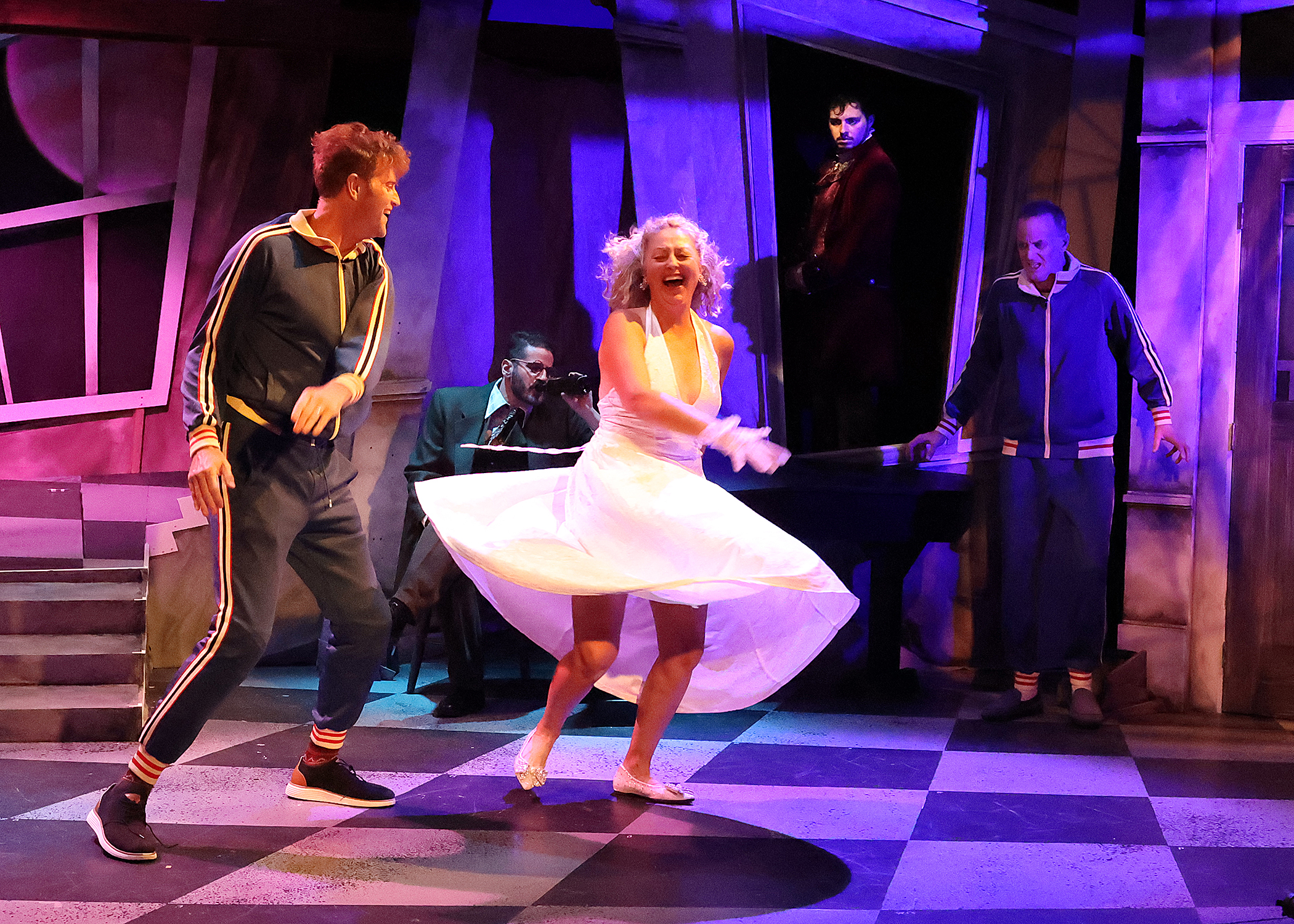
    And indeed it is. Thanks to the absolutely brilliant scenic design of Ryan McGettigan, the House is very much a main character in the drama. The set is Escher-esque, with Dr. Seuss-like angles to doors and windows and a sinister moon lurking outside.

    Ed has been summoned because, despite not having seen Roderick since their time together at a boys’ prep school 29 years ago, he is Roderick’s only friend—and Roderick’s twin sister Madeline (Jade Schuyler) is dying. (“What kind of cancer?” a frustrated Ed will later ask Dr. Dumas; “terminal,” is the response.)

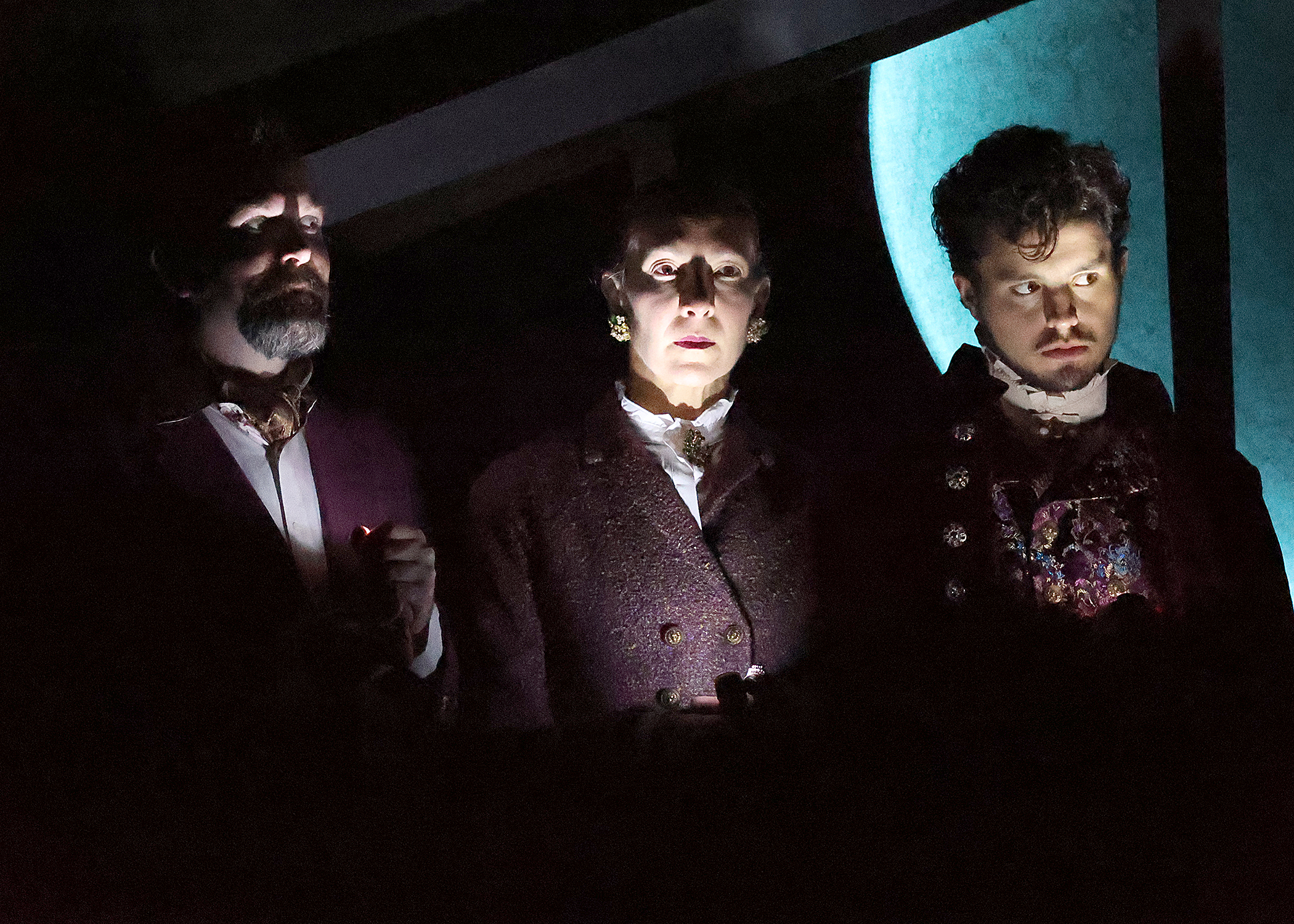
    Roderick is a man haunted in many ways. After he left the academy, he retired to the House, which he has not left since. In Poe’s original story, it is the seemingly sentient House that haunts him; but Hoppe’s genius (and the inspired and deft direction of James P. Byrne) introduces past Ushers in the form of Roderick’s deceased  parents Jerome (Jefferson Thomas) and Constance (Jenn Pina), as well as his long-dead grandfather Manfredo (a very dapper Colin Bourget). Are they ghosts—or hallucinations? It’s left unclear.

    Madeline’s appearances are manic: she swoops out of her room in swirling layers of a frothy white nightgown (nod to Cat Perry for costume design) to enchant Ed and disrupt Roderick. Her mental health seems far more fragile than does her physical being, but Ed seizes on the latter as a vehicle to try and make sense of the House. Why not a second opinion? Why no contact with the outside world? Why not repair the damned place? “Your insulation,” Roderick warns him, “is thinner than you think.”

    And so it is: the House has seemingly taken hold of Ed as the play progresses, with his telephonic check-ins with his family becoming more and more bizarre.

    Steers is completely mesmerizing in his portrayal of Roderick—he captures the longing, the loneliness, the fragile mental health, and the soul-agony of one of Poe’s most memorable characters. He wears gloves (“if you touch something,” he tells Ed, “you become it”), even to play the piano, and he creates a slight pause before certain nouns to give them a bizarre weight, underlining the possibility that the apparitions he sees and hears exist only in his mind.

    The apparitions themselves are absolutely fabulous. They live mostly as ancestral portraits, but when they come out to play they add a full measure of agony to Roderick’s world. Wearing a frock-coat, Bourget in particular is delicious, veering from campy (“God, I love dramatics!” he exclaims) to threatening and quite scary. They are focused on Madeline’s death: “Let Dr. Dumas finish the job,” Manfredo urges Roderick. “Madeline must go!”

    Ed nearly succumbs to the House’s sway; after an interaction with his own deceased parents (Jack Kerig and Julie Allen Hamilton) and after being seduced by Madeline, he gives himself wholeheartedly to the bizarre alternate reality it harbors.

    Things don’t end well, as Poe readers will already know. Dr. Dumas does apparently “finish the job,” and Madeline is pronounced dead; Roderick insists that Ed help him place her body in the crypt beneath the House (where else?), but she’s been buried alive and doesn’t rest easy.  And neither Roderick nor the House can ultimately survive.

    Cape Rep programs remind audiences that this isn’t a play appropriate for children, and I concur, specifically for its strengths: John Malinowski’s lighting design and J. Hagenbuckle’s music and sound design are both eerie and quite frightening at times. But for adults, this is an amazing production—far superior to the Netflix adaptation of a few years ago—of an unforgettable story.


    review by Jeannette de Beauvoir

    photos by Bob Tucker/Focalpoint Studio

    More Recent Provincetown News